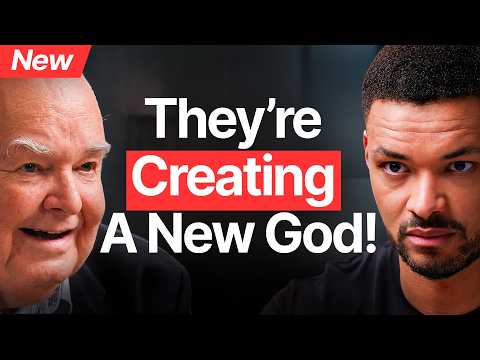
Chapter: AI Worship and the Danger of Treating Robots as Conscious
Summary
In this episode, mathematician and Christian apologist John Lennox argues that faith in God is grounded in evidence and reason, not blind belief, while warning against treating artificial intelligence as a godlike entity. He emphasizes that consciousness—including appreciation of life, beauty, and God—is a "hard problem" that AI cannot replicate, as machines lack qualia, senses, and genuine understanding. Lennox contrasts Christianity with other belief systems, noting that while devout Muslims and Hindus may experience similar psychological peace, he questions whether subjective feeling proves truth. He asserts that Christianity is unique in offering grace and forgiveness rather than merit-based salvation, and that rejecting this grace is a form of arrogance. The discussion also touches on transhumanism, the historical trial of Jesus for political terrorism, and C.S. Lewis's observation that the golden rule appears across many religions, suggesting a moral hardwiring. Lennox draws on Iain McGilchrist's work to critique the West's overemphasis on left-brain rationalism at the expense of context and beauty. Ultimately, he presents faith as a reasoned trust based on personal evidence, analogous to trusting a spouse or science, and argues that reductionist materialism leads to meaninglessness, pointing instead to a larger reality beyond the physical.
Key Points
AI Worship and Dangers
Forgiveness and Personal Experience
John Lennox's Mathematical and Faith Background
Transhumanism and AI as a Threat to Identity
Jesus' trial as a confrontation between political power and truth
AI lacks consciousness and qualia
AI as a new religion and idolatry
Left-brain dominance and the need for context
Christianity offers unique peace and forgiveness
Faith is based on evidence and trust, not blind leap
Christianity is not a merit-based religion
Analogy of the cookbook illustrates grace vs. works
Grace is the core of Christian certainty
CS Lewis and the Golden Rule across religions
Differences in core beliefs among faiths
Psychological benefits of devout belief across religions
Thomas's need for evidence as a model
Jesus's warnings about hell were for religious bigots
AI lacks consciousness and the five senses
Consciousness is the hard problem of science
AI can mimic output but lacks understanding
AI creativity is debated; it can create but not know
Alan Turing and the imitation game approach
Consciousness includes appreciation of life and God
Machines cannot fully simulate the human mind
Indicators point to a bigger world beyond reductionism
There are worship groups that worship AI because it has qualities associated with God.
UnverifiedThe great pioneers of modern science were all believers in God.
UnverifiedMathematics works and is evidence of a word-based universe.
UnverifiedA serial killer on death row said he met Jesus and was forgiven.
UnverifiedTranshumanism aims to go beyond the human, merging with machines.
UnverifiedJesus was put on trial for political terrorism.
UnverifiedPilate conducted the trial himself and declared Jesus innocent.
Partially supportedMachines do not have qualia or consciousness.
UnverifiedAI experts are not trying to construct intelligence because they don't understand consciousness.
UnverifiedThere are already worship groups for AI.
UnverifiedThe West has focused on the left hemisphere for 500 years, neglecting the right.
UnverifiedChristianity offers peace, forgiveness, and eternal life that no other belief system provides.
UnverifiedFaith is based on evidence and trust, similar to trusting a spouse or science.
Partially supportedChristianity is not a merit-based religion; it is about grace and acceptance through Christ.
Partially supportedRejecting grace is arrogance.
UnverifiedCS Lewis found the golden rule in 40 different religions and philosophies.
UnverifiedDevout Muslims and Hindus get the exact same psychological meaning boost and sense of peace as devout Christians.
UnverifiedThe only people to whom Jesus talked about hell were religious bigots.
UnverifiedAI does not have any of the five senses, which are connected to consciousness.
UnverifiedConsciousness is called the hard problem and no one knows what it is.
UnverifiedAI can be programmed to recognize patterns but has no awareness of the process of seeing.
UnverifiedAlan Turing and Peter Norvig accepted the imitation game and are not trying to create conscious machines.
UnverifiedThere is no way a machine will ever be able to simulate a human mind completely.
UnverifiedIndicators within nature, science, and human experience tell us there is a bigger world.
UnverifiedAI Worship and the Danger of Treating Robots as Conscious
0:00
Faith, Science, and Personal Experience of Forgiveness
0:50
Transhumanism, AI as Idolatry, and Human Identity
4:30
Jesus’ Trial: Political Power vs. Truth
15:02
AI Lacks Consciousness and Qualia
16:23
Left-Brain Dominance and the Need for Context
19:54
Christianity’s Unique Peace, Forgiveness, and Eternal Life
30:03
Faith as Evidence-Based Trust, Not Blind Leap
31:58
Grace vs. Works: The Core of Christian Certainty
33:06
The Golden Rule Across Religions and CS Lewis
1:00:06
Core Differences Among Faiths and the Role of Evidence
1:01:06
Psychological Benefits vs. Truth: Thomas as a Model
1:02:06
Jesus’ Warnings About Hell Were for Religious Bigots
1:05:11
AI, Consciousness, and the Hard Problem of Science
1:16:05
Alan Turing, the Imitation Game, and Machine Limitations
1:18:55
Indicators of a Bigger World Beyond Reductionism
1:20:13